
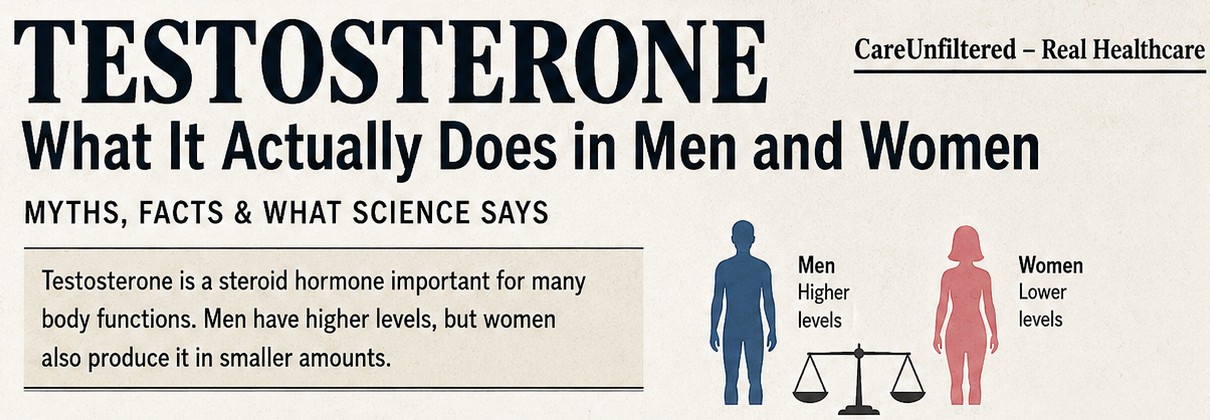

Testosterone: What It Actually Does in Men and Women — Myths, Facts & Science
Is testosterone only a “male hormone”? Does it control muscle, sex drive, fertility, aggression and energy? Let’s separate science from social-media claims.
CareUnfiltered – Real Healthcare
Testosterone is one of the most misunderstood hormones.
It is often called the “male hormone” and linked only with muscles, masculinity and sexual performance. But both men and women produce testosterone. The main differences are the amount produced, where it comes from and how the body responds to it.
Testosterone is a steroid sex hormone and androgen involved in reproductive function, muscle and bone health, red-blood-cell production and other biological processes.
However, it is not a magic hormone for energy, confidence or muscle. A low or high blood-test result does not automatically mean disease.
What exactly is testosterone?
Testosterone is produced mainly by:
Testes in males
Ovaries and adrenal glands in females
Its production is controlled by the hypothalamus, pituitary gland and gonads. Testosterone can also be converted into other hormones, including DHT and estradiol.
The body continuously regulates, transports and uses testosterone rather than simply producing it and leaving it unchanged.
Testosterone in men vs women
Healthy adult men generally have much higher testosterone levels than healthy adult women. However, levels vary between individuals, and laboratory ranges are sex- and assay-specific.
The claim that:
“Women don't have testosterone.”
is false. Women produce and need testosterone too.
What does testosterone do in men?
Testosterone contributes to:
Puberty and sexual development
It supports facial and body hair growth, voice changes, muscle and bone development, and reproductive tissues.
Muscle and body composition
Testosterone supports muscle protein synthesis and lean body mass. But muscle growth also depends on resistance training, nutrition, sleep, genetics and overall health.
Bone health
Testosterone helps maintain bone strength. Some of it is converted into estradiol, which is also important for bones.
Red blood cells
Testosterone stimulates red-blood-cell production. Excessive treatment can therefore cause erythrocytosis, an abnormal rise in red blood cells.
Sexual function
It contributes to sexual desire and reproductive physiology. However, erectile dysfunction is not automatically caused by low testosterone. Diabetes, blood-vessel disease, medications, stress, poor sleep and other conditions can also play a role.
What does testosterone do in women?
Women produce testosterone in smaller amounts, but it may contribute to:
Sexual desire and function
Muscle and bone physiology
Overall androgen activity
Reproductive and endocrine function
A single low testosterone result does not prove that a woman has a general “androgen deficiency.” The Endocrine Society has cautioned against diagnosing such a condition in healthy women because there is no universally reliable threshold for it.
Testosterone: Myths vs Facts
Myth 1: “Testosterone is only a male hormone.”
FACT: Both men and women produce testosterone.
Men generally produce more, but testosterone is biologically active in females too.
Myth 2: “High testosterone automatically means you are stronger and healthier.”
FACT: More is not always better.
Excess testosterone, whether naturally produced or taken as medication or anabolic steroids, can cause harm. The goal is appropriate hormone function—not the highest possible number.
Myth 3: “Low testosterone causes every man's tiredness.”
FACT: Fatigue has many causes.
Poor sleep, obesity, stress, depression, anemia, chronic disease, medications and sleep disorders can all cause tiredness.
Male hypogonadism should be diagnosed only when compatible symptoms occur along with consistently and clearly low testosterone levels.
Tired ≠ automatically low testosterone.
Myth 4: “One testosterone test is enough.”
FACT: Testosterone levels fluctuate.
They can change with time of day, illness, sleep, food intake, medications and laboratory methods.
For suspected male hypogonadism, doctors usually confirm low testosterone with repeat morning tests.
Myth 5: “Testosterone therapy is an energy booster.”
FACT: It is a medical treatment, not a wellness supplement.
Testosterone replacement may help men with properly diagnosed hypogonadism. It is not recommended simply for more energy, muscle or sexual performance without a medical indication.
Myth 6: “Testosterone improves fertility.”
FACT: External testosterone can reduce sperm production.
It suppresses the hormonal signals that stimulate the testes. Men planning fertility should not start testosterone therapy casually and should discuss alternatives with a doctor.
Myth 7: “High testosterone makes everyone aggressive.”
FACT: Human behaviour is more complicated.
Aggression, confidence and competitiveness are influenced by brain biology, personality, environment, social circumstances and several hormones and neurotransmitters.
Myth 8: “Women do not need testosterone.”
FACT: Women naturally produce testosterone.
But a low test result does not automatically mean treatment is needed. Evidence for testosterone therapy in women is specific. The 2019 Global Consensus Position Statement found support mainly for appropriately assessed hypoactive sexual desire disorder in postmenopausal women, not for general energy, cognition or wellbeing.
Myth 9: “Testosterone boosters are naturally safe.”
FACT: Marketing is not proof.
Supplements advertised as testosterone boosters are not proven treatments for testosterone deficiency. They may contain multiple ingredients and can carry risks or interact with medicines.
What happens when testosterone is genuinely low in men?
Possible symptoms include:
Reduced sexual desire
Erectile difficulties
Low energy
Reduced muscle mass
Lower bone density
Reduced body hair
Mood changes
Fertility problems
These symptoms are not specific to testosterone deficiency, so diagnosis requires both symptoms and properly measured hormone levels.
Low testosterone may result from problems in the testes, the brain-pituitary system, obesity, chronic illness, certain medications or other endocrine conditions.
Low testosterone is a medical finding that needs a cause—not simply a number that must be increased.
Can lifestyle affect testosterone?
Yes. Overall health can influence testosterone levels. Helpful factors include:
Maintaining a healthy body weight
Regular physical activity
Adequate sleep
Balanced nutrition
Limiting excessive alcohol
Managing medical conditions
However, claims that one food, herb or exercise can dramatically “boost testosterone” are usually oversimplified.
Testosterone and ageing
Testosterone generally declines with age in men, but ageing alone does not mean every older man has testosterone deficiency.
Diagnosis still depends on symptoms plus consistently low and accurately measured testosterone. Normal ageing should not automatically be labelled a hormone disorder.
Should everyone get a testosterone test?
Usually, no.
Routine screening of men without symptoms is not generally recommended. Testing is more appropriate when symptoms, signs and medical history suggest possible testosterone deficiency.
Results should be interpreted according to sex, age, symptoms, test timing, laboratory method and overall health.
The biggest misconception about testosterone
Testosterone is not simply a “manliness hormone.” It is a complex hormone involved in several body systems.
The better question is not:
“How can I get the highest testosterone possible?”
It is:
“Is my testosterone appropriate for my body and clinical situation?”
The Bottom Line
Testosterone is important—but it is not a magic hormone.
Both men and women produce testosterone, although men generally have much higher levels.
Low testosterone can cause genuine health problems in men, but symptoms alone are not enough for diagnosis. One abnormal test also does not automatically prove deficiency.
Testosterone therapy may benefit appropriately diagnosed men, but it is not a general energy, muscle, anti-ageing or fertility treatment. In women, testosterone therapy should be considered only for evidence-supported clinical indications.
Don’t chase a testosterone number. Understand the biology, investigate the cause and treat a genuine medical problem when one exists.
Evidence behind this article
This article is based on Endocrine Society guidance, the 2019 Global Consensus Position Statement on testosterone therapy for women and peer-reviewed research on testosterone in males and females.
SEO Primary Keyword: testosterone
Secondary Keywords: testosterone hormone, testosterone in men, testosterone in women, low testosterone symptoms, testosterone levels, testosterone deficiency, testosterone myths, testosterone facts, testosterone therapy, natural testosterone
Long-tail Keywords:
What is testosterone and what does it do?
Testosterone in men and women explained
What are the symptoms of low testosterone?
Does testosterone affect fertility?
Can women have low testosterone?
Is testosterone only a male hormone?
Testosterone myths and facts
When should testosterone be tested?
Suggested URL Slug:/testosterone-men-women-myths-facts
Suggested Meta Title:
Testosterone Explained: Men, Women, Myths & Facts | CareUnfiltered
Suggested Meta Description:
What is testosterone? Learn what testosterone does in men and women, low testosterone symptoms, fertility, therapy and common myths based on medical evidence.
Medical Disclaimer
CareUnfiltered – Real Healthcare provides health information for general awareness and education. This article is not a diagnosis or a substitute for consultation with a qualified doctor. Testosterone testing and treatment decisions should be based on symptoms, medical history, examination and appropriately performed laboratory testing.