
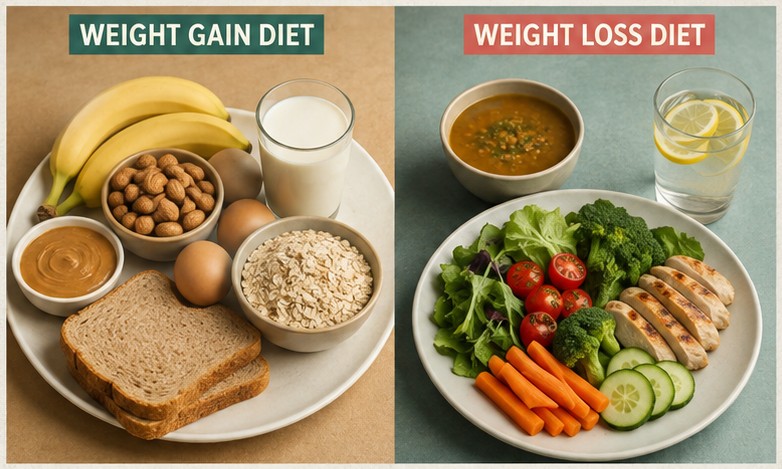

Weight Gain Diet vs Weight Loss Diet: What Different Foods Actually Do
Weight Gain Diet | Weight Loss Diet | Healthy Weight Management | Calorie Surplus | Calorie Deficit | Protein Foods | High-Fiber Foods
Have you ever wondered why the same food may help one person gain weight while fitting perfectly into another person’s weight-loss diet?
The answer is simple: foods do not have fixed “weight gain” or “weight loss” labels. Your body weight is influenced mainly by your total calorie intake, activity level, metabolism, appetite, muscle mass and overall eating pattern.
If you consistently eat more energy than your body uses, weight tends to increase. If you eat less, weight tends to decrease.
But an important question remains:
Are you gaining or losing fat, muscle or both?
That is why food quality, protein, fibre and exercise matter.
Calories: The Basic Principle
Your body uses energy for breathing, digestion, movement, exercise, brain function and maintaining body temperature.
Weight gain: calorie surplus
Weight loss: calorie deficit
Weight maintenance: calorie intake roughly matches energy use
However, calories are not the only consideration. A healthy diet should also provide adequate protein, carbohydrates, healthy fats, vitamins, minerals and fibre.
Weight gain does not require junk food, and weight loss does not require eliminating rice, roti or carbohydrates.
Foods That Can Support Healthy Weight Gain
If you are underweight or struggling to gain weight, focus on nutrient-dense calories rather than relying on sweets, fried foods or sugary drinks.
1. Nuts, Nut Butters and Seeds
Examples include:
peanuts
almonds
walnuts
cashews
peanut butter
pumpkin, sunflower, chia and flaxseeds
These foods provide calories, healthy fats, protein and other nutrients in small portions. They can be useful if you have a low appetite.
Example:
Oats + banana + peanut butter + milk or soy milk
However, healthy foods can still be high in calories. Large portions may create a significant calorie surplus.
2. Whole Grains and Starchy Foods
Examples include:
rice
oats
whole-wheat roti
potatoes
sweet potatoes
whole-grain bread
millet
Carbohydrates provide energy for daily activities and exercise. Increasing portions of nutritious carbohydrate-rich foods can help with weight gain.
These foods can also fit into a weight-loss diet when portions and total calories are controlled.
3. Protein-Rich Foods
Protein is especially important if your goal is to gain muscle rather than only body weight.
Vegetarian options include:
dal
beans
chickpeas
soy
tofu
paneer
curd or Greek yogurt
milk, if tolerated
nuts and seeds
Resistance training combined with adequate protein supports muscle growth better than simply eating more calories.
A large meta-analysis found that protein supplementation during resistance training improved muscle size and strength, with benefits generally not increasing beyond around 1.6 g protein/kg/day in the analysis. This is not a universal requirement; individual needs vary.
4. Dairy and Dairy Alternatives
Milk, curd, paneer, fortified soy milk and soy yogurt can provide protein and calories.
A smoothie made with milk or soy milk, oats, banana and nut butter can be more calorie-dense than eating fruit alone. But adding sugar, syrup or sweetened ingredients can increase calories quickly.
Foods That Can Support Weight Loss
Weight loss generally requires a sustainable calorie deficit. The goal is not to eat as little as possible, but to choose foods that provide nutrition and fullness without excessive calories.
Energy Density
Energy density refers to how many calories a food provides relative to its weight or volume.
Lower-energy-density foods, such as vegetables, fruits, soups and legumes, can provide larger portions for fewer calories. This may help control hunger.
A large bowl of vegetables can contain far fewer calories than a small handful of nuts. Both can be nutritious, but their calorie density is different.
1. Vegetables
Vegetables provide water, fibre, vitamins and minerals with relatively few calories.
Examples include:
cucumber
tomato
spinach
cabbage
cauliflower
carrot
bottle gourd
beans
capsicum
Preparation matters. Vegetables cooked with a large amount of oil may contain considerably more calories than vegetables prepared with little oil.
2. Whole Fruits Instead of Juice
Whole fruits contain water and fibre and usually require more chewing than juice.
Examples include:
apples
oranges
guava
watermelon
papaya
berries
pears
Fruit can absolutely be part of a weight-loss diet. You do not need to eliminate bananas or mangoes simply because they contain carbohydrates.
Whole fruit is generally more filling than drinking the same calories as juice.
3. Protein and Fibre
Protein can support muscle retention during weight loss and help with fullness. Fibre-rich foods such as vegetables, fruits, legumes and whole grains may also help control appetite.
The same dal, tofu, paneer or yogurt can appear in both weight-gain and weight-loss diets. The difference is usually portion size, total calories and what the food is eaten with.
Common Foods: Weight Gain or Weight Loss?
Rice
Rice is neither automatically a weight-gain nor a weight-loss food.
For weight gain:
Rice + dal + vegetables + curd + additional healthy fat
For weight loss:
Controlled rice portion + dal + plenty of vegetables + protein
The food has not changed. The portion and overall meal have changed.
Roti
Whole-wheat roti can fit into any diet. Consider:
number and size of rotis
what you eat with them
oil or ghee added
total daily calorie intake
Potatoes
Boiled or baked potatoes are different from fries, chips or heavily buttered potatoes. Preparation can dramatically change calorie density.
Oil, Ghee and Butter
Fats are important nutrients, but they are energy-dense. Small amounts can add significant calories.
They may help someone struggling to gain weight, but extra oil, ghee, butter, mayonnaise or creamy sauces can make weight loss more difficult. Portion awareness is key.
Sugar, Sweets and Ultra-Processed Foods
Sugary drinks, sweets, cakes, pastries, biscuits and chips can increase calorie intake quickly without providing much fullness.
They may contribute to weight gain, but they are not ideal “healthy weight-gain foods.” Nutritious calorie sources are generally a better choice.
Quick Comparison
| Food/Category | Weight Gain | Weight Loss |
|---|---|---|
| Nuts | Useful in larger or increased portions | Healthy, but portions matter |
| Peanut butter | Calorie-dense and useful | Can fit, but easy to overeat |
| Rice | Useful for increasing calories | Fits in controlled portions |
| Roti | Useful | Can fit |
| Potatoes | Useful depending on preparation | Can fit, especially boiled or baked |
| Fruits | Useful in a calorie surplus | Excellent in appropriate portions |
| Vegetables | Important | Particularly useful |
| Dal and beans | Excellent | Excellent |
| Tofu and soy | Excellent | Excellent |
| Paneer | Provides protein and calories | Can fit; portion and fat content matter |
| Oil and ghee | Easy ways to add calories | Measure portions |
| Sugary drinks | Increase calories quickly | Usually a poor choice |
| Sweets and junk food | Can increase weight | Best limited |
Very few foods belong exclusively to weight gain or weight loss.
Amount, preparation, combination and total daily intake matter most.
A Practical Strategy
For Healthy Weight Gain
Focus on:
nutritious calorie surplus
adequate protein
resistance training
consistency
sufficient sleep
The NHS suggests gradually increasing intake, with around 300–500 additional calories per day as one possible starting point for adults. This is not a universal prescription. Requirements vary by body size, activity, age, health and goals.
Unexplained or sudden weight loss should be medically evaluated rather than treated only by eating more.
For Healthy Weight Loss
Focus on:
sustainable calorie deficit
adequate protein
vegetables and fibre-rich foods
sensible portions
fewer liquid calories
regular physical activity
Extreme restriction is usually difficult to maintain and may compromise nutrition.
The Same Food Can Have Different Roles
Banana
For weight gain:
Banana + oats + peanut butter + milk or soy milk
For weight loss:
One banana as part of a balanced meal or snack
Rice
For weight gain:
Larger portion + dal + vegetables + protein + healthy fat
For weight loss:
Moderate portion + more vegetables + adequate protein
Paneer
For weight gain:
A larger portion can provide protein and calories
For weight loss:
A smaller portion or lower-fat option may fit better
Nuts
For weight gain:
An easy way to increase calories
For weight loss:
Nutritious, but calorie-dense, so portions matter
The Bottom Line
Food does not have a fixed “weight gain” or “weight loss” label.
Its role depends on:
Calories + portion size + protein + fibre + preparation + total diet + physical activity
Rice, roti, potatoes, bananas, paneer and dal can all fit into different dietary goals.
For healthy weight gain:
Increase nutritious calories + protein + strength training.
For healthy weight loss:
Create a sustainable calorie deficit + prioritize protein, fibre and minimally processed foods + stay active.
There is no single fat-burning food or magical weight-gain food. Your overall eating pattern matters more than any individual ingredient.
Frequently Asked Questions
1. Can I gain weight by eating healthy food?
Yes. If healthy foods provide more calories than your body uses, weight can increase. Nuts, seeds, dairy or alternatives, whole grains and protein-rich foods can support healthy weight gain.
2. Can I lose weight while eating rice?
Yes. Rice can be part of a weight-loss diet when the portion and total calorie intake fit your needs.
3. Is banana good for weight gain?
Bananas provide calories and carbohydrates and can fit into a calorie-surplus diet. Eating one banana alone does not automatically cause weight gain.
4. Is paneer good for weight loss?
Paneer provides protein and can fit into a weight-loss diet, but it may also be calorie-dense. Portion size matters.
5. Are nuts good for weight loss?
Yes. Nuts provide healthy fats, protein and other nutrients, but they are energy-dense, so portion control is important.
6. Do carbohydrates cause weight gain?
Carbohydrates do not automatically cause weight gain. Consistently consuming more total energy than your body uses can lead to weight gain.
7. Should I eat junk food to gain weight?
No. Nutritious calorie sources are generally a better strategy than relying heavily on ultra-processed foods.
8. Is eating less always better for weight loss?
No. Extreme restriction can be difficult to sustain and may reduce nutrition. A moderate, sustainable calorie deficit is usually more practical.
Medical Disclaimer
This article is for general health education and awareness. It is not a substitute for individual medical advice, diagnosis or treatment.
Calorie and nutrient requirements vary according to age, sex, body size, activity level, medical conditions, medications and personal goals. If you have unexplained weight loss, difficulty gaining weight, obesity, diabetes, kidney disease, digestive problems, an eating disorder or another medical condition, consult a qualified doctor or registered dietitian before making major dietary changes. Sources consulted: National Institute of Diabetes and Digestive and Kidney Diseases (NIDDK), NHS, Mayo Clinic and peer-reviewed systematic reviews/meta-analyses.