

Hemodialysis or Peritoneal Dialysis? What’s the Difference?
When the kidneys are working normally, they quietly do a lot of important work. They remove waste from the blood, help control fluid levels, and maintain the right balance of minerals in the body.
But when the kidneys become severely damaged and can no longer do enough of this work, dialysis may be needed. If you've recently heard terms like hemodialysis or peritoneal dialysis, you may wonder: What's the difference? Which one is better? And how does dialysis actually work?
Let's break it down in simple language.
What Exactly Is Dialysis?
Dialysis is a treatment that helps remove waste products and excess fluid from the blood when the kidneys aren't able to do enough of the job themselves.
Think of your kidneys as the body's natural filtration system. Dialysis acts as an artificial way of performing some of that filtering.
There are two main types of dialysis:
Hemodialysis
Peritoneal dialysis
Both can remove waste and extra fluid, but they do it in very different ways.
1. What Is Hemodialysis?
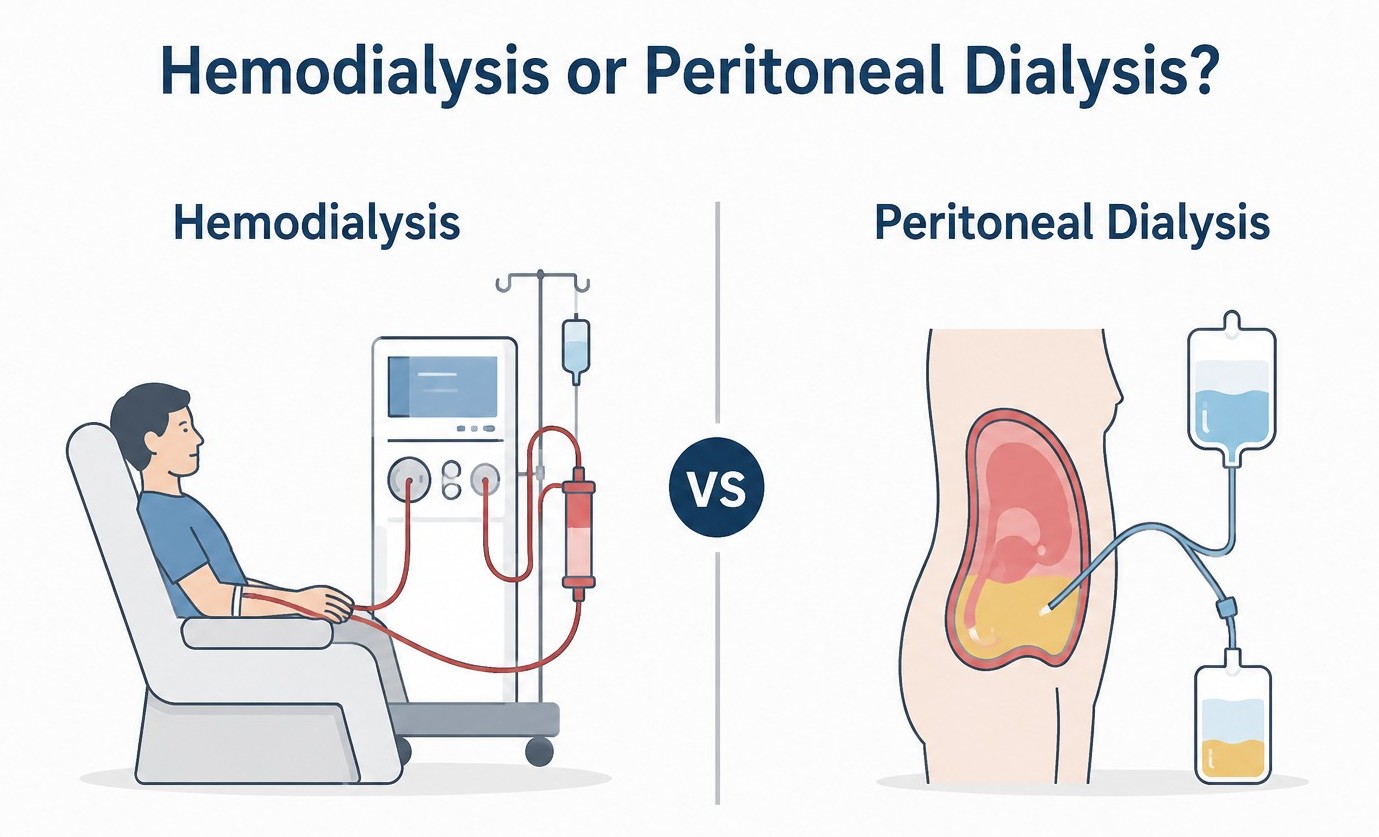
Hemodialysis uses a special machine and a filter called a dialyzer to clean the blood.
During treatment, blood is taken from the body through vascular access, passed through the dialyzer, and then returned to the body.
Inside the dialyzer, waste products and excess fluid are removed from the blood.
A typical hemodialysis session at a dialysis center commonly lasts around 3–5 hours, and many people receive treatment about three times a week. However, the exact schedule can vary depending on the person's medical situation and the dialysis plan prescribed by the healthcare team.
Where is hemodialysis done?
It may be performed:
At a dialysis center
In a hospital
In some cases, at home
Home hemodialysis can offer more flexibility, but it requires proper training, equipment and support.
What does it feel like?
The treatment itself isn't usually painful, although inserting the needles for vascular access can be uncomfortable. Some people may feel tired, dizzy or have muscle cramps during or after treatment.
2. What Is Peritoneal Dialysis?
Peritoneal dialysis works differently.
Instead of using an external blood-filtering machine, it uses the peritoneum, the lining inside your abdomen, as a natural filtering membrane.
A soft tube called a catheter is placed into the abdomen. A special dialysis solution is put into the abdominal cavity through the catheter.
The solution stays there for a certain period. Waste products and extra fluid move from the blood across the peritoneal membrane into the dialysis solution.
The used solution is then drained and replaced with fresh solution.
This process is called an exchange.
Can peritoneal dialysis be done at home?
Yes. One of its major advantages is that it can generally be performed at home after appropriate training.
There are two common approaches:
Continuous Ambulatory Peritoneal Dialysis (CAPD):
The person performs exchanges manually several times during the day.
Automated Peritoneal Dialysis (APD):
A machine called a cycler performs exchanges, usually while the person sleeps.
Hemodialysis vs Peritoneal Dialysis: What's the Difference?
| Feature | Hemodialysis | Peritoneal Dialysis |
|---|---|---|
| Main filter | Dialyzer machine | Peritoneal membrane |
| Blood outside the body? | Yes, during treatment | No |
| Usually performed | Often at a center; sometimes at home | Usually at home |
| Frequency | Often around 3 sessions/week | Usually performed daily |
| Equipment | Dialysis machine | Dialysis solution + catheter; APD uses a cycler |
| Lifestyle | Fixed treatment sessions may be required | Can offer more flexibility |
| Main access | Vascular access | Abdominal catheter |
| Important infection concern | Vascular-access infections | Peritonitis |
Neither option is automatically "better" for everyone.
The choice depends on several factors, including kidney function, overall health, lifestyle, home situation, vascular access, personal preference and the advice of the nephrologist.
So, Which Dialysis Should You Choose?
This is where things become personal.
Two people with kidney failure may have completely different needs.
Someone who prefers treatment at a dialysis center and has reliable access to the facility may find hemodialysis practical.
Another person may prefer the flexibility of home-based peritoneal dialysis and be comfortable managing the treatment with proper training.
There can also be medical reasons why one method is more suitable than the other.
That's why dialysis isn't a one-size-fits-all treatment.
Your nephrologist can explain the benefits, limitations and risks of each option based on your individual health and circumstances.
One More Important Point
Dialysis is not the same as curing kidney failure. It replaces some important kidney functions, but it doesn't completely reproduce everything healthy kidneys do.
For some people with kidney failure, kidney transplantation may also be considered as a treatment option, depending on their medical condition and eligibility.
The important thing is not to panic when you hear the word "dialysis." It may sound frightening at first, but dialysis is an established treatment that helps many people manage kidney failure and continue living their lives.
Final Takeaway
Hemodialysis cleans the blood using a dialysis machine and an external filter. Peritoneal dialysis uses the lining of your abdomen as the filtering membrane.
Both have advantages and disadvantages. The right choice depends on the person's health, lifestyle, preferences and medical needs.
If you or someone in your family has been advised to start dialysis, don't hesitate to ask the nephrologist questions. Understanding the treatment can make the process feel much less overwhelming.
Frequently Asked Questions
1. Is peritoneal dialysis better than hemodialysis?
Not necessarily. Both are established forms of dialysis, and the better option depends on the individual's medical and personal circumstances.
2. Can dialysis be done at home?
Yes. Home hemodialysis and peritoneal dialysis are both possible for appropriately selected and trained patients.
3. How long does hemodialysis take?
A conventional session commonly takes around 3–5 hours, but the schedule varies from person to person.
4. Is dialysis permanent?
It depends on the cause and severity of kidney failure. Some people may need dialysis temporarily, while people with permanent kidney failure may require long-term dialysis or may be evaluated for transplantation.
Primary Keyword: Hemodialysis vs Peritoneal Dialysis
Secondary SEO Keywords: dialysis, types of dialysis, hemodialysis, peritoneal dialysis, kidney failure, dialysis treatment, dialysis process, kidney health, renal failure, dialysis at home.
SEO Title: Hemodialysis vs Peritoneal Dialysis: What's the Difference?
Meta Description: Confused about hemodialysis vs peritoneal dialysis? Learn how both types of dialysis work, their key differences, benefits, and what to consider.
Suggested URL Slug: /hemodialysis-vs-peritoneal-dialysis
Image ALT Text: Hemodialysis vs peritoneal dialysis explained
Internal Linking Opportunities:
Kidney Health: Basic Guide
Understanding Kidney Failure
What Is a Kidney Transplant?
How to Read a Kidney Function Test
Disclaimer: This article is for general health awareness and educational purposes only. It does not replace medical diagnosis or advice from a qualified healthcare professional.