
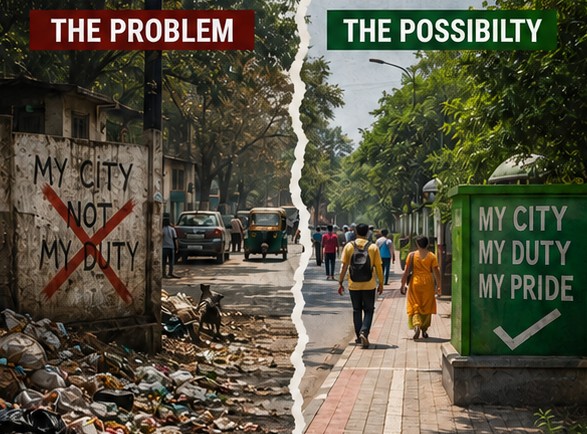

Civic Sense in India: Are We Losing It, or Are We Just Changing?
Why do we keep our homes clean but ignore the road outside? Why do we follow rules only when someone is watching?
The answer is civic sense—understanding that public spaces also belong to us.
It includes following traffic rules, standing in queues, avoiding littering and spitting, respecting pedestrians, controlling noise, protecting public property, disposing of waste properly and ensuring our convenience does not become someone else’s problem.
The real question is:
Has civic sense declined, or are we simply noticing it more?
What Is Civic Sense?
Civic sense is the everyday behaviour that helps people live respectfully in a shared society.
It is not determined by education, wealth or status. An educated person may still litter, while someone with little formal education may patiently stand in a queue, help others and keep their surroundings clean.
Civic sense is about behaviour, responsibility and habits.
Civic Sense: Then vs Now
Earlier generations also faced littering, public spitting, traffic violations and encroachments. What has changed is the scale, speed and visibility of modern life.
Rapid urbanisation, more vehicles, crowded roads, plastic use and social media mean that poor behaviour can affect thousands of people quickly. A traffic violation that once went unnoticed can now be recorded and shared online.
So the issue is not simply that people today lack civic sense. The bigger question is:
Why do people know the right behaviour but still choose not to follow it?
Knowing the Rule Is Not Enough
People may know that they should not litter, jump red lights, spit in public or cut queues. But knowledge alone does not guarantee responsible behaviour.
When rule-breaking becomes common, it can turn into a social norm.
One person crosses a red light, another follows, and soon people think:
“Everyone does it.”
The rule has not changed, but social expectations have.
The “Everyone Is Doing It” Problem
People copy what they see around them.
If everyone follows a queue, cutting it feels wrong. If many people are cutting the queue, others may think:
“Why should I wait?”
This creates a cycle:
One violation → others copy it → violation becomes normal → responsible behaviour looks unusual.
That is why civic sense cannot improve through advice alone. Public systems and social norms must also support good behaviour.
Why Do People Behave Differently at Home and Outside?
Many people keep their homes clean but treat public spaces differently because they feel more responsible for what they personally own.
My house → my responsibility.
Public road → someone else’s responsibility.
But public spaces belong to everyone. When millions of people think someone else will clean up, cities become dirty.
We need to move from:
“Who will clean this?”
to:
“Why did I make it dirty?”
Is Lack of Civic Sense Only a People’s Problem?
No. Citizens have responsibility, but systems matter too.
Without accessible bins, reliable waste collection, safe footpaths, public toilets and consistent enforcement, responsible behaviour becomes difficult.
So the civic environment depends on:
Citizen behaviour + infrastructure + enforcement + social norms + leadership.
Positive attitudes alone are not enough. They must be supported by practical systems and sustained behaviour change.
Civic Sense Is Also a Public Health Issue
Civic behaviour affects health and safety.
Poor waste management and sanitation create unhygienic surroundings. Unsafe driving can cause serious injuries and deaths. Speeding, wrong-side driving, red-light violations, mobile-phone use and failure to wear helmets or seat belts are major road-safety risks.
A “small” traffic violation can have serious consequences for someone else.
Civic Sense Is Not Only About Cleanliness
A civic-minded person also respects other people’s rights and comfort.
Drive safely instead of aggressively.
Do not push or shout in public transport.
Respect queues.
Keep noise under control.
Do not damage public property.
Keep footpaths clear.
Dispose of waste properly.
Remember that roads are not only for cars.
Society is built from small actions repeated millions of times.
Why Punishment Alone Cannot Solve Civic Sense
Strict laws are necessary, but punishment alone cannot create responsible citizens.
The goal should be:
“I follow the rule because I understand why it exists.”
A strong civic culture combines:
Understanding + habit + social expectations + fair enforcement.
What Can Improve Civic Sense?
1. Start Early
Schools should teach practical citizenship, including road safety, waste segregation, queue discipline, respect for public property and helping vulnerable people.
These lessons should be taught through practice, not only lectures.
2. Parents Must Set an Example
Children copy behaviour. Telling them not to litter while throwing waste from a car sends the opposite message.
3. Make Good Behaviour Easy
Cities need accessible bins, reliable waste collection, safe footpaths, crossings, clear signs, public toilets and easy reporting systems.
4. Enforce Rules Fairly
Rules need clear penalties, consistent enforcement and equal treatment, regardless of wealth or status.
5. Make Responsibility Socially Normal
Instead of admiring people who say, “Mujhe koi kya kar lega?”, society should respect those who say:
“Mujhse kisi aur ko problem nahi honi chahiye.”
What Can One Person Do?
Start with these simple habits:
Do not litter or spit in public.
Follow traffic rules even when nobody is watching.
Do not block footpaths or entrances.
Stand in queues.
Keep public spaces usable for others.
Protect public property.
Control unnecessary noise.
Help people who need assistance.
Encourage responsible behaviour politely.
Think about how your actions affect others.
One person may not change India, but millions of people acting responsibly can.
The Real Problem Is Not “People Today”
Civic sense is not a generation problem. It is a culture-and-system problem.
Children learn from the behaviour they see. If adults follow rules and respect public spaces, responsible behaviour becomes normal. If they repeatedly hear “Chalta hai,” small violations become acceptable.
The Civic Sense We Need
India does not need perfect citizens. It needs people who understand:
“My freedom should not unnecessarily become someone else’s problem.”
Celebrate without disturbing an entire neighbourhood. Drive safely. Put wrappers in bins. Disagree without disrespect. Use public property responsibly.
That is civic sense.
The Final Question
Instead of asking:
“Why is the government not keeping the city clean?”
ask:
“What did I do today to keep it clean?”
Instead of asking whether others follow traffic rules, ask:
“Did I follow them when nobody was watching?”
Civic culture is created on roads, in queues, schools, buses, neighbourhoods, public toilets and our own homes.
A better India begins when “someone else will do it” becomes “I will do my part.”
SEO Keywords
Primary keyword: civic sense in India
Secondary keywords: civic sense, civic responsibility, importance of civic sense, public behaviour in India, responsible citizen, civic awareness, good citizenship
Meta Description:
Understand civic sense in India, why public behaviour matters and how citizens, schools, families and systems can improve cleanliness, safety and responsibility.
Disclaimer:
This article is for public awareness and educational purposes. Civic behaviour is influenced by individual habits, social norms, infrastructure, enforcement and wider social conditions.